
The Academic Interview: A Marathon
Background: I applied for a position I saw posted on ALA JobLIST and was contacted about 2 weeks after the search period ended to set up a phone interview. I completed an hour long phone interview with a 4-member search committee. The majority of the questions were more about my work-related attitudes and philosophies than about my hard skill set and previous positions. About 2 weeks later, I received an email invitation for an inperson interview. After accepting the offer, I was given a set of potential dates and a presentation topic. While some interviews require you to teach a lesson, I was asked to prepare a 30-minute presentation about the role of a particular type of subject specialist in an academic library. Additional emails followed to set up my travel arrangements and meals. About a week before the interview, I was sent a formal (intimidating) itinerary. I took the time to Google search of the 20-some people I was going to meet with. Specifically, I looked for pictures (so I would be able to recognize them) and information about their job responsibilities and their interests. I was scheduled to meet with a mix of librarians, teaching faculty, and administrators over the course of two days.
I chose to drive to my interview (I was offered flight accommodations, but thought the short drive would give me a better sense of the area). My first contact, a member of the search committee, arrived to pick me up in the hotel lobby, and we completed an hour tour of some of the libraries on campus. The tour was relatively casual and more of a time for me to learn. I was told about the unique roles of each individual library and how staff members often worked in teams. I had time to ask basic questions, and some of the new information I learned I was able to incorporate into my presentation. Additionally, I took out a few points in my presentation when I realized they were not highly relative to the unique aspects of this position.
After an hour, my contact walked me back to the hotel and I was picked up by a higher adminstrator for a driving tour of the campus. It’s important to remember that the university staff are trying to sell you on the university and moving to that particular area. Feel free to ask questions about communities where staff tend to live, the cost of living, transportation to campus, etc. After driving around campus, we visited a few nice neighborhoods where many staff members chose to live. We soon arrived in town and were met with the head of the search committee for dinner. Both staff members told me about their favorite restaurants and hang out spots in town. Overall, our chats were relatively informal. They both recognized that moving to a new place for a new job was a big adjustment, and wanted me to feel free ask honest questions: Where do people live? Where is the nearest mall? What do people do for fun? Don’t feel silly, it’s your life and you should do all the research you can to determine if both the position and location are a good fit for you! This dinner experience will help you relax during the more formal interview, as you feel that you know a few friendly and familiar faces. I was dropped off back at the hotel around 9 p.m.
I suggest practicing your presentation at least twice before bed, with a timer and looking into a mirror. It is important to remember that your audience will care just as much about your presence and style as they do about your content. They want to get a sense of how you are as a public speaker and how comfortable you would feel providing library instruction. My topic was ultimately opinion-based, so I chose 5 key points and elaborated on each. I was sure to focus on aspects mentioned in the job description brought up over dinner, including openness to change, creativity, and emerging technologies.
Flash forward to the next morning:
I set an alarm extra early the next morning. It is important to leave time to check out and have your bags stored (believe it or not, there was a line to check out at 7:30 a.m.)!
I was met by 4 staff members (1 who had given me my first tour and 3 new faces) for breakfast at 7:45 a.m. I strategically ordered last, so when the three staff members all chose the buffet breakfast, I chose the same (I wanted to show that I was flexible). It is important to remember that while conversations can be casual, they are still making impressions of you. Try to be friendly and give them a sense of who you are, but avoid anything too personal or that could be interpreted in multiple ways. Additionally, this sounds simple, but try to avoid messy foods and plan on eating quickly: the majority of the meal was spent answering questions, with not much time to eat.
After breakfast, I was escorted to the room where I would give my presentation. I was ready to “get it over with,” so I could relax again. Please, please save your presentation in your email, on a flashdrive, and another backup method for good luck! It happened that the room I was in did not have a place for me to plug in my flash drive, so I had to pull it from my email. I chose to not bring formal notes, because I wanted to speak from memory and not spend time constantly looking down. While the entire staff of the library was invited (OH MY), only about 20 people came and only a few tuned in to watch live video feed. The audience included librarians from various departments, paraprofessional library staff, teaching faculty, library administrators, the assistant dean, library director, and the search committee.
After the initial introduction, I began to relax and go through my presentation just as I had practiced. At this point, your content is set; it is up to you to come across as friendly, a good public speaker, creative, passionate, and genuinely interested in your audience. I tried to make eye contact with different audience members and move around. My presentation was a mixture of things I saw as important to librarianship, current roles, potential future roles, and example of projects I had completed in my professional experiences.
While I was given 30 minutes to present, I strived to finish early to ensure I would not run over. An additional 30 minutes were scheduled for questions. Many of the audience members who asked questions began by complimenting an aspect of the presentation, which made me feel better!
After the presentation (time to breathe again), I was walked by a staff member whom I had not met to a different building to meet with about 10 members of the library staff who would work closely with the new hire. There was no formal list of questions; members introduced themselves and were each given a chance to ask me about my background, philosophies, subject knowledge, work experiences, etc.
Next, I was escorted to meet with a human resources representative who discussed health insurance, retirement, family support, criteria for promotion and ranks, professional development stipends, funds available to support relocation, etc. This was less of an interview and more of an informational session.
Still with me? Tired yet? Almost time for lunch!
I was picked up by a staff member I had met earlier and taken to meet with the assistant dean of the school the librarian would serve as a liaison to. I recognized him from my presentation earlier, so I was glad to know he had an introduction to who I am and my vision of the library. He began by telling me how supportive he was of the library and how open he was to developing creative new ways for the library to impact student learning. He listened to my ideas and our conversation shifted from current values of a librarian to potential new programs I had mentioned earlier and how I would go about implementing and evaluating them.
At about noon, I was picked up by another member of the search committee and taken to an on campus restaurant for lunch. I was joined by a professor and 2 members of the search committee. Chat shifted between casual talks (where are you from, what are your hobbies, etc.) to additional questions about my professional experiences.
After lunch, a member of the search committee took me on a walking tour of a few other campus libraries, popular areas, and beautiful view points. I had worn my comfortable heels, anticipating a lot of walking that day! He was very excited to show off the campus to me, once again reminding me they are also trying to sell themselves and their campus to you.
After our tour, I met with the library director, who I had dinner with the previous night and had seen twice this morning. We discussed logistics (when is your timeline to start if we were to hire you, how do you feel about relocating, after all you have learned are you still excited for this job) and I answered additional interview questions. The director gave more more details about the timeline of the search and estimated it would be at least 2 weeks until they made a decision.
Finally (by now it’s 3 p.m.), I had my most formal interview of the day. I knew this was coming and loaded up on coffee. They also brought my a water bottle, which I was glad to have after talking for most of the day! The search committee had a packet of questions, and each took a turn asking questions and writing my responses. The questions were a mix of what if situations (how would you balance X and Y if Z), experiences (how often do you handle x reference questions), philosophies (tell me about a teamwork situation which turned out negative, what do you see as the future of libraries), promotion (how committed are you to scholarship, professional organizations, furthering your formal education, committee work, etc). After this, I had a final one on one interview the head of the search committee. The majority of questions asked here were about my past experiences in group work and my views about myself (most proud moment, personal weaknesses, etc.) After this (it’s almost 5 p.m.), the search committee member walked me back to my hotel.
Tired after reading this? Believe me, I was tired about living it (but feeling super relieved). I returned home and sent each search committee member a personal thank you note, each discussing something unique from my encounters with that individual.
Art Library Internship
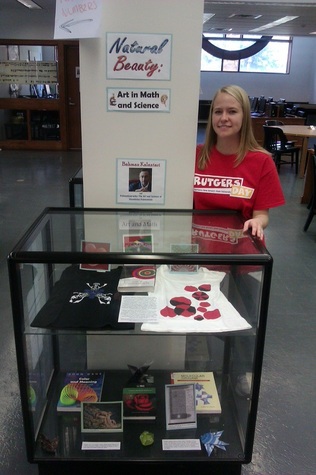
The second exhibit I did was called Natural Beauty: Art in Math and Science. This was a very time-consuming but fun exhibit to curate. I learned after doing the first exhibit to spend less time on the text since few people actually read it anyway. I did spend a lot of time researching and making props for the exhibit. This involved everything from folding origami to assembling a foam praying mantis to tracking down Hubble telescope pictures. Here’s a picture of one of the cases in this exhibit:
roslyngrandy@gmail.com
Internship Opportunity: Instruction at Rutgers
Below is a great internship opportunity for an MLIS student who wants to gain teaching experience.
Rutgers Libraries in New Brunswick is looking for an intern interested in information literacy instruction for undergraduate students. The intern will assist in coordinating instruction and will participate in providing instruction to students in a variety of programs, including English writing and transfer student seminars. The student will also research and help develop improved methods of instruction deliver, including, but not limited to, the creation of online tutorials. A successful candidate will have completed at least one semester in the MLIS program, experience searching Rutgers databases, and strong presentation skills.
Contact Jill Nathanson, Kilmer Library, jill.nathanson @ rutgers.edu, (848) 445-3608
NJLA 2013 Conference
Here’s the SCARLA poster:

That being said, I attended many different but interesting programs:
- First Steps Toward RDA
- Conversation Starter: Book Group Hits and Misses
- Reference 2.0 in a Flash (presented by four Rutgers MLIS students, including SCARLA’s vice-president, Kristen Mapes)
- PA Forward | Pennsylvania Libraries: Building Opportunities for Libraries
- Outreach in the City: Programs for Kids
- Librarians in the 21st Century: Multicultural Leadership
- Do’s and Don’ts of Library Programming for the 20s/30s Crowd (via live-tweeting)
- ACRL National and You
- I Can Borrow What?
- Library Laws You Need to Know
- The Year’s Best Graphic Novels 2012
I also toured the Exhibits Hall, perused the poster sessions, conversed about trends with new and veteran librarians, celebrated hard work during the NJLA Awards Ceremony, listened to Laura Lippman’s keynote address, and (accidentally) ate lunch with Stephen Abram, the Wednesday keynote speaker. (Let that be a lesson in the importance of speaking up and networking.) I left Atlantic City Wednesday afternoon with a brain full of new ideas and thoughts, and a greater sense of the LIS professional community.
Who’s going to ALA Midwinter in Philadelphia this January?
~ Cassidy Charles, SCARLA co-president, Fall 2013
cassidycharles24 @ gmail.com
Setting and Assessing Instructional Goals

- You need to understand learner contexts before you start teaching. For instance, if someone doesn’t know how to use a mouse, it will be difficult to teach them how to use an online database.
- A written performance objective should be specific and use action verbs to help its specificity. Phrases like “know,” “understand,” or “gain an appreciation of” are hard to measure. Phrases like “select,” “write,” and “identify” are easier to measure because they align with a behavior.
- With that said, a well-written learning objective will lend itself to developing an assessment. For example, an objective like “The student will be able to identify and list the differences between MLA format and other citation formats,” is better than “The student will understand citation style.”
- You develop the assessment right after you’ve developed the learning objectives–before you’ve developed the instructional strategy or instructional materials, which should be closely aligned with the objects and how you’ll measure them.
- The process is iterative and allows for revision. If students aren’t achieving the learning outcomes you expect, you can look at your materials, strategy, assessments, or objectives at any point in the process and modify them to create better success.
Jen Hunter
jah123 @ camden.rutgers.edu
Looking forward to NJLA 2013
As a newer MLIS student, I’m pretty excited to attend the NJLA conference this year because it will be my first library-focused conference. I can’t wait to go to the poster sessions, check out the programming, and see the exhibitors. But what I’m most excited about is networking.
One of my favorite parts of library school so far has been talking with working library professionals and finding out what they do, and why they love what they do. Everyone I’ve met has been enthusiastic about sharing and “converting” new librarians. It’s also been helpful to get informal advising about coursework. What kinds of skills do they expect new graduate applicants to have? How can classes help to fill those competencies?
In addition to networking, these are the sessions I want to check out:
- Tuesday, 9-9:50: Giving college-bound students a head-start
- Tuesday, 10-10:50: Digital libraries 2013
- Tuesday, 2-2:50: Reaching online learners
- Tuesday, 4-4:50: Connecting to collections
- Tuesday, 5-6: New librarian & student meet up
- Wednesday, 9-9:50: Three strategies for engaging students in learning information literacy
- Wednesday, 9-11: Technology innovation forum
- Wednesday, 10:10-11: Assessing unique academic populations
- Wednesday, 2:30-3:20: ACRL National and You
- Wednesday, 3:30-4:20: Redefining the Faculty-Librarian Relationship
What are you looking forward to at the conference?
Jen Hunter
jah123 @ camden.rutgers.edu
SCARLA at NJLA 2013
Don’t miss SCARLA at NJLA 2013. We’ll be presenting a poster: “What’s the Big Deal About Library Instruction: Getting library instruction experience as an MLIS student.”
Our session is on Tuesday, June 4 from 10-11 a.m.
Here’s the abstract:
The Student College, Academic, and Research Libraries Association (SCARLA) is a group of MLIS students at Rutgers University interested in academic librarianship. A recent panel session discussion sponsored by SCARLA revealed that SCI students had an interest in gaining instructional experience in a professional context as interns or volunteers. Our poster presentation will detail SCARLA’s practical problem-solving effort to increase student awareness about and experience with library instruction.
Revel: Oasis for NJ Librarians
Hi all,
I just returned home from “Retooling 4 Tomorrow: New Jersey Library Association Annual Conference.” NJLA 2012 took place at the new Revel Hotel in Atlantic City, NJ from Monday June 4th to Wednesday June 6th. The Revel can only be described as the new standard for luxury and grandeur in Atlantic City. Beautiful ocean front views greeted participants as they approached the registration area and continued to captivate us throughout the week. We had excellent weather all three days and many of us spent most of our official ‘coffee-break time’ exploring the Revel’s expansive outdoor decks and lush garden meeting centers.
As hinted in the conference title, NJLA 2012 was all about innovation, positivity, exploring new technologies, and creating new community connections. We were all encouraged to discover what we as library professionals do best and how to continue expanding our strengths to suit the changing needs and wants of our communities. The conference activities consisted of a mixture of practical advice concerning instruction, purchasing agreements, technologies, social media, etc. and theoretical discussions about how to continue proving our worth in the future.
Monday afternoon hosted a preconference, while Tuesday and Wednesday were workshop days that last from 9am to 5am. At any given time, there were at least 5 different places to be; a broad range of activities appealed to librarians from wide ranging backgrounds. Attendees were able to custom design their NJLA schedule and keep track of all their desired locations on the free NJLA 2012 iphone app. In-between sessions, we visited the exhibitors hall to learn more about companies providing a wide range of potential services to libraries-everything from publishers to architects, and smart phone application software to authors and musicians!
Laura Palumbo and I presented a poster about SCARLA’s inaugural year at the Student Poster Session Tuesday morning. 5 of the 6 student posters at the session came from our fellow classmates at Rutgers. It was exciting to learn from each other and represent our school!
After the poster session, Laura and I attended a leadership luncheon where NJLA President Susan O’Neal, introduced us to the soon to be new NJLA President Karen Klapperstuck. I have had the pleasure of getting to know Karen and her vibrant personality, creativity, energy, and passionate dedication to this organization will no doubt lead to a very successful and innovative upcoming year in the New Jersey Library Association. We wish Karen the best of luck as she begins her term in the follow weeks!
I personally chose to attend many of the events sponsored by the College and University Section of NJLA. This section hosted panel-like discussions as well as more hands-on activities to help us learn more about instruction methods and research techniques. Academic librarians from Universities in New York, Pennsylvania, Connecticut, Maryland, California and, of course, New Jersey, gave presentations and workshops. Some of these many events included:
- E-Reader Lending at Princeton University Library
- Harnessing Your Connections: Developing Your Personal Learning Network
- Retooling the CUS Website with Drupal
- Retooling Library Instruction by Analyzing Student Information Literacy Skills
- On the Road to Information Literacy Success
- Using the New American Factfinder and FDsys to Locate the Current Census and Other Federal E-Documents
- ACRL-NJ’s Research Forum award and presentations
SCARLA’s own Miraida Morales hosted a session entitled “Digital Library Toolkit: Building a Small Digital Library on a Shoestring.” Miraida shared her experiences with the 1st digital library project for the National Library of Puerto Rico, sharing valuable information about planning processes, choosing platforms and metadata schemes, and providing positive public relations. Miraida’s unique skillset will serve her well in her new career as a digital archivist. We wish her the best of luck as she begins her wonderful new career and continues to take the library world by storm!
On Wednesday afternoon, I attended the NJ Colleges and Universities Luncheon. I had the pleasure of getting to know academic librarians from across the state. All were very kind and offered valuable advice about navigating the local job market and finding opportunities to continue my education. During the luncheon, awards were presented to noteworthy members of the organization. Wednesday also marked the 10th anniversary of the Technology Innovation Award. Previous winners also came to share how their work has continued to grow and develop in the years since their initial awards.
NJLA also hosted many events specifically targeted to MLIS students and librarians looking for jobs. Professional librarians volunteered to host resume review sessions to provide students with 1 on 1 advice. Some of the events specifically aimed towards MLIS students included:
- The Art of Managing Your Brand
- Why Didn’t They Call Me!? Dos and Don’ts to Get the Interview Call Next Time?
- How to succeed in Job interviews for Libraries
- Library Student & New Librarian Mixer
The conference was extremely hospitable to students and I recommend that MLIS students join in this wonderful opportunity to attend the conference next year. The Revel has been booked for the next 3 NJLA conferences, so you too can experience all that this beautiful, beach front location has to offer. For more information on the conference location, visit the Revel’s official site http://www.revelresorts.com/.
Overall, the conference was a great mixture of networking, professional development, knowledge dissemination, hands on instruction, and most imporatantly, FUN! Comical key note speakers captivated our attention with their energy, humor, and dedication to brazing new paths for the future of libraries and library professionals. NJLA Leaders provided inspirational messages to MLIS students and made us feel welcome and appreciated by the organization. For more details about conference panels, presenters, and activities, visit the official NJLA webpage:http://njlaconference.info/.
Next, join me in traveling to Anaheim for the ALA 2012 conference from June 21st to 26th. If the idea of going to a Rutgers SCI alumnae reunion in the Magic Kingdom Ballroom doesn’t excite you, imagine having the opportunity to network with librarians from across the country! For more information, visit the official conference website:http://www.alaannual.org/.
Kelly LaVoice
How to Present a Poster by SLA
I just attended an online webinar presented by Tara Murray, Director of Information Services/Librarian for the American Philatelic Research Library, and hosted by SLA. The webinar was a great concise outline of poster construction and presentation, and Tara agreed to let me share the highlights with you. You can get more information from her blog at http://diylibrarian.org/archive/2012/04/10/posters/
I know this will come in handy for our upcoming poster at NJLA!
- Read the instructions! Follow the directions for poster size and format.
- Include your name on your poster- nobody wants to be anonymous.
Generally, your poster should include:
- Title of your poster
- Authors and affiliations
- Contact information
- Intro/abstract- check with instructions if required or not wanted
- Methods, if a research study, or a description
- Conclusion
- References and acknowledgements (optional)
Other helpful info:
- Posters can be created using Adobe Illustrator, or MS PowerPoint.
- Your title font should be at least 1.5 inches, the rest of the text at least 24 pt font- readable from 3-4’ away. All caps are difficult to read, as are fancy fonts. Sans-serif is good for titles; serif fonts may be easier to read in the body.
- Color is good for highlighting important points, but don’t go crazy. Contrast is important–don’t use light text on light background.
- Leave space around your text. Posters are visual- use images.
- Don’t laminate–it makes the poster heavy, and causes glare.
- Carry your poster in a tube or carrying case, especially if flying.
- Handouts are a good place for additional information that didn’t fit on the poster, and for contact information. They should remind people of your poster.
- Read the instructions so you are prepared with mounting materials, and check to see if you have a table for handouts, and electricity for a laptop. On the day of your presentation, arrive early to set up. Stay near your poster to answer questions.
Thanks Tara and SLA!
~Laura Palumbo, co-webmaster
Internship at MOMA
While visiting the Museum of Modern Art on a RUSLA field trip last fall, I discovered their internship program and, specifically, the opportunities available for library science graduate students interested in art librarianship, archives, and research. I submitted my application for a spring 2012 internship program by the October 2011 deadline and heard back from the reader’s services librarian (a Rutgers Library Science Alumnae!) in December. As a second semester student, I was ineligible to receive academic credit for the internship program; however students interested in pursuing the internship for credit would be able to do so.
For anyone interested in art librarianship in special, art, or museum libraries, I highly recommend you take advantage of this amazing opportunity just an hour away from New Brunswick! Why intern at the Museum of Modern Art? You will have unlimited free access to the museum as well as exclusive invitations to attend staff events including gallery openings with world renown artists, film premieres, and free admission to many other art museums throughout the country. You can also reserve free tickets for friends and family even if you will not be joining them (for up to 6 guests per day). Sounds too good to be true? It gets better. Interns receive 40% off at the gift shop, book store, and design store throughout the duration of the internship.
Each Tuesday, the 40 interns from the curatorial, research, and business divisions attend classes and events together to learn more about the various departments working behind the scenes to keep the museum at the forefront of displaying ‘the art of our time’. The museum is closed to the public on Tuesdays, so interns partake on private exhibition tours with the curators who designed and executed the exhibits. This is an opportunity to experience, first-hand, the extensive research involved in curating exhibits and publishing exhibition catalogs.
My favorite intern activities thus far have included: a private tour of collection storage in MoMA Queens (the closest I will probably ever be to a genuine Picasso!), meeting with the director of the museum to discuss strategic planning, an introduction to digital media design applications, and touring the conservation department for painting and sculpture. During the weekly classes, interns network with other graduate students throughout the metropolitan area studying art, museum studies, librarianship, and/or information technology. Staff members leading the weekly classes always give background information about their educational and professional backgrounds and give interns advice about navigating the job market.
As the MoMA library intern, I split my time between the branches in Manhattan and Queens. Because of the nature of the discipline, the majority of materials continue to be in print form and require multiple sites to accommodate the massive collection of materials on modern and contemporary art. The collection includes materials from the mid-19th century to the current times, focusing on painting, sculpture, drawings, photography, film, architecture, design, performance, and more! The library has approximately 300,000 books and exhibition catalogs, over 40,000 files on individual articles and exhibitions, 300 periodical subscriptions, PADD files (Political Art Documentation and Distribution) and unique artist books that will cause you to ‘rethink’ the traditional book format. Ever seen a book made completely of chocolate? How do you preserve such a resource? Another reason to check out the MoMA library!
Working with MoMA collections caused me to rethink my perception of books as mass-produced information sources. Materials in our collection are simultaneously works of art themselves as well as information and archival sources of information. MoMA has many unique items that must be handled with care, preserved for audiences of the future to better understand the cultures that produced the art movements. I have been lucky enough to shadow our preservation library assistant to learn techniques for repairing damaged materials and properly housing new materials to proactively prevent damage. It is amazing to see acid-stained books, with pages completely detached and extreme spine damage, be repaired to almost unrecognizable levels! Since we are only able to take 12 classes during our time at Rutgers, this is a great way to learn about physical and digital preservation if you are unable to schedule an academic class in these areas.
During my internship, I assist with cataloging and reference work. I have the opportunity to practice with new cataloging software platforms and learn more about full-level cataloging for research-based institutions. For an intern project, I am adding geographic descriptor terms to records for artist books to make keyword searching in the catalog easier for staff and visitors. During my days shadowing our reference librarian, I learn more about the unique process for art research using primarily print-based resources. The MoMA library is open to the public 4 days a week, so interns have the opportunity to interact with museum staff, curatorial assistants, visiting scholars, students from art programs throughout New York City, artists, film makers, and other professionals.
If any of this sounds exciting or interesting to you, please visit the MoMA internship webpage to learn more:http://www.moma.org/learn/courses/internships#types. If multiple people express interest in visiting the library, the library staff could schedule a private tour for Rutgers students on a Tuesday when the library is closed to the public.
If you have an interest in art, archives, museum studies, or are just looking for an interesting internship to learn more about cataloging, reference, or preservation, definitely consider applying for a MoMA internship in the future! Private gallery tours, free museum admission, and access to one of the largest modern art library collections in the world: I promise, you’ll be glad you did it!
-Kelly LaVoice
KML254@eden.rutgers.edu